
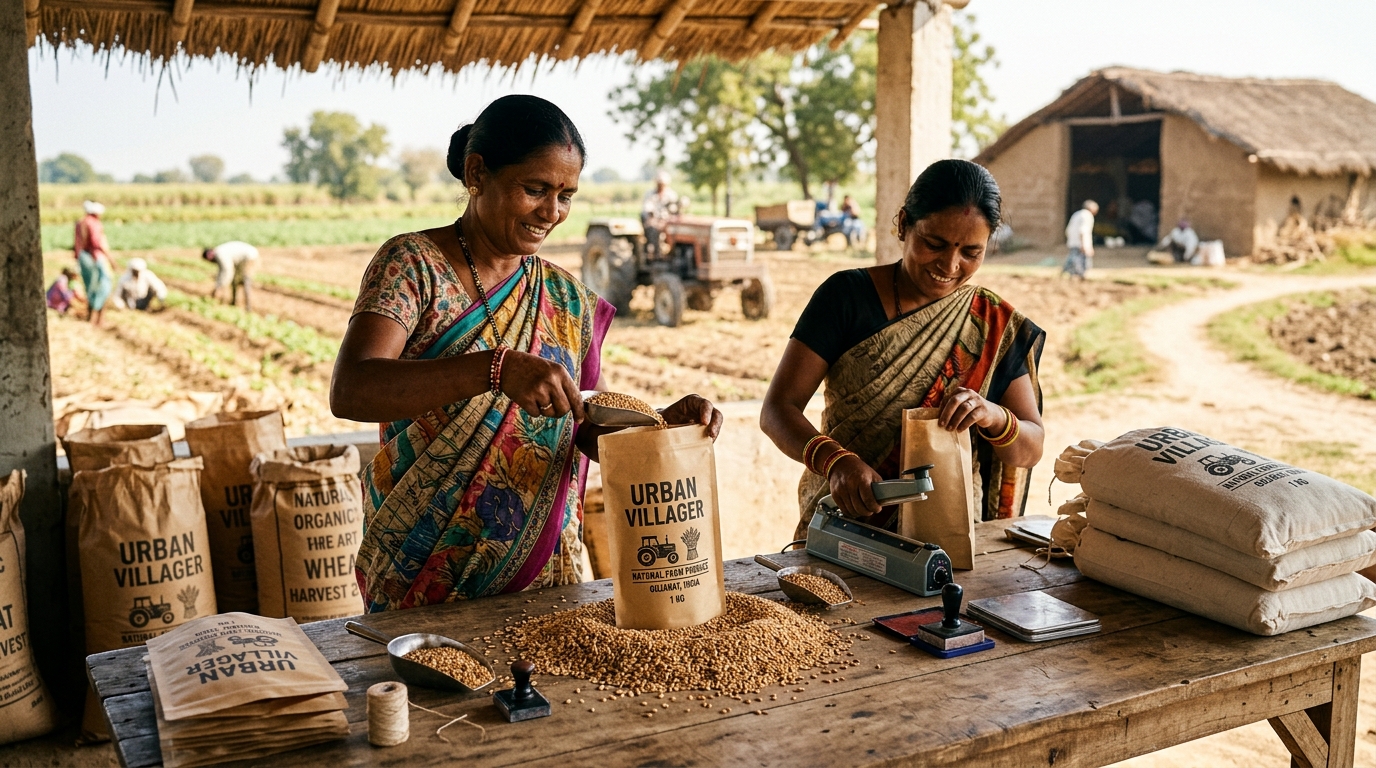
Every morning across India, millions of conscious consumers step into supermarkets and pay ₹60 to ₹80 for a kilogram of wheat flour, or ₹70 for a pouch of fresh bajra. Yet, if you travel into rural Gujarat, the farmer who spent five grueling months nurturing that crop receives barely ₹20 to ₹22 per kilogram at the local agricultural market yard (APMC Mandi). Where does 70% of your food money actually go?
The Anatomy of Mandi Exploitation: The 6-Layer Middleman Trap
For decades, conventional food distribution has operated as an extractive cartel where the farmer takes all the financial, climatic, and biological risks, while anonymous middlemen capture the lion’s share of retail profits. Let us trace where your rupee vanishes:
- The Village Middleman (Kaccha Arhtiya): Lends money for seeds and inputs at high interest, forcing the farmer to sell distressed harvest at below-market rates before the grain even leaves the village.
- The APMC Mandi Auctioneer (Pakka Arhtiya): Levies Mandi taxes (6-8%), handling charges, auction fees, and arbitrary deductions for “moisture loss”.
- Wholesale Grain Speculators & Silo Operators: Purchase harvest cheaply, store it in massive commercial warehouses, and pump toxic chemical gas fumigants (like aluminum phosphide) to keep insects away while waiting for retail prices to rise.
- Industrial Millers & Bleachers: Strip the nutritious living germ and fibrous bran to produce shelf-stable flour, blending old damaged inventory with fresh grain.
- Corporate Branding & Aggregation Giants: Pour millions into television commercials, plastic packaging, and celebrity endorsements.
- Supermarket Retail Shelves: Charge up to 30% slotting fees and shelf margins just to place the packet at eye level.
“When an entire supply chain exists solely to extract margins without touching the soil, the farmer stays trapped in debt and the consumer eats chemically preserved, stale food. Direct selling is not just economics—it is agricultural liberation.” — Kaushik Chaudhary (Founder) & Het Joshi (Co-Founder), Urban Villager
Meet The Farmers Behind Urban Villager

Kaushik Chaudhary
Founder

Het Joshi
Co-Founder
The Economics: Conventional Mandi Model vs Urban Villager Direct Model
Here is an unabridged, real-world comparison of the economics for a typical 100 kg harvest of traditional Wheat or Bajra:
| Cost Component | Mandi Chain(100 kg) | Urban Villager(Direct Farm) |
|---|---|---|
| Gross Farmer Revenue | ₹2,200(₹22/kg) | ₹5,800(2.6x More) |
| Middlemen, Broker & Mandi Taxes | ₹850(Lost) | ₹0(Direct Farm) |
| Storage & Gas Fumigation | ₹550(Chemical) | ₹0(Neem Leaf) |
| Packaging, Sorting & Batch QR | ₹350(Generic) | ₹500(Traceable QR) |
| Supermarket & Retailer Margin | ₹1,650(Corporate) | ₹0(Direct Gate) |
| Doorstep Logistics & Delivery | ₹0(Store trip) | ₹900(Home Delivery) |
| Net Farmer Profit Share | ~18%of rupee | 65%–70%Retained! |
How Our Direct Model Empowers Real Agriculture
When farmers earn only ₹20 to ₹22 per kg in the Mandi, they are financially compelled to chase sheer tonnage. They spray urea and DAP to force artificial plant growth and flood fields with pesticides because a 10% crop loss would wipe out their entire family savings.
By establishing a direct relationship with conscious households through Urban Villager, our financial paradigm is flipped completely:
- Freedom to Reject Chemicals: Because we receive a fair price directly from you, we can afford the labor-intensive care required for Desi cow dung composting, Jeevamrut, and herbal sprays.
- Preservation of Traditional Seeds: Native Desi Wheat and Desi Bajra produce pure, unadulterated nourishment that supports easy digestion and robust gut health. Fair direct margins make chemical-free farming completely viable.
- Living Soil Investment: We reinvest our direct profits into deep rainwater harvesting recharge borewells, soil tests, and solar-powered micro-sprinkler grids right here on our farm.
The Consumer Advantage: What You Gain by Bypassing the Chain
Direct selling is not an act of charity—it is an upgrade for your family’s health and wellness:
- Absolute Origin Guarantee: You know exactly which field in Gujarat grew your food and can visit our farm anytime.
- Freshness Measured in Days, Not Months: Your grain is packed on order, retaining natural bran fiber and nutritious germ.
- Cryptographic Traceability: Every bag bears a live batch QR code linking directly to independent laboratory residue test certificates verifying zero harmful chemicals.
By choosing Urban Villager, you cast a vote for a farming economy rooted in human dignity, honest nourishment, and living soil.